Early Andronovo intrusion in the Eastern Tianshan

xinjiang-andronovo-xiaohe-tianshanbeilu-bronze-age

Recent paper (behind paywall) The Baigetuobie cemetery: New discovery and human genetic features of Andronovo community’s diffusion to the Eastern Tianshan Mountains (1800–1500 BC), by Zhu, Zhang, et al. The Holocene (2020).

Interesting excerpts (emphasis mine):

The Baigetuobie cemetery (Balikun County, Hami City) is located on the eastern slope of the Baigetuobie Mountains, about 54 km west of the Balikun County and 40 km southwest of the Balikun Lake.

Baigetuobie cemetery

The cemetery is relatively small in scale and the burials are rather concentrated. The graves are marked on the surface by stone slabs visible from approximately 0.05 to

Read the rest “Early Andronovo intrusion in the Eastern Tianshan”

Proto-Hungarian Homeland: East and West of the Urals?

magyar-pecheneg-migration-steppes

The study of eastern Uralic branches is clearly underdeveloped relative to western ones, and in desperate need of a proper reassessment. This linguistic obscurity contrasts heavily with the decades-long tradition of categorically pinning ethnolinguistic labels (“Ugric” or “Hungarian”) to different prehistorical cultures by (post-)Soviet archaeology, and with the identification of Hungarian as Turkic continuing Turanist trends; 20th century papers showing one of both trends rarely if ever withstand basic scientific scrutiny.

The following is a combination of rewritten excerpts about Ugric in general and Hungarian in particular, as well as some other texts on the linguistic predecessor of the Old … Read the rest “Proto-Hungarian Homeland: East and West of the Urals?”

Proto-Uralic Homeland (VIII): Earliest External Contacts

bandtoepfer-donau

This post is part of a draft on palaeolinguistics and the Proto-Uralic homeland. See below for the color code of protoforms.

14. Earliest PU ~ PIE contacts

14.1. Indo-Uralic?

The most reliable correspondences to propose an Indo-Uralic phylum come from basic morphological comparisons. Some of the most frequently mentioned ones include (e.g. Čop 1975, Kortlandt 2002, Bjørn 2019, or Lubotsky 2019):

  • Nominal endings:
  • PU nom.sg. *-Ø ~ PIA nom.-acc.sg. *-Ø (in neuter athematic nouns).
  • PU acc.sg. *-m ~ PIA acc.sg. *-m.
  • PU dual *-ki(-) ~ PIA nom.-acc.du. *-h₁.
  • PU abl. *-tA ~ PIA gen.-abl.sg. *-es/*-os/*-s.
Read the rest “Proto-Uralic Homeland (VIII): Earliest External Contacts”

Proto-Uralic Homeland (VII): Kinship & Numerals

schnurkeramiker-graber

This post is part of a draft on palaeolinguistics and the Proto-Uralic homeland. See below for the color code of protoforms.

12. Kinship Terminology

12.1. Immediate Family

PU? (Saa.?, Fi.?, Md.?, Ma.?, Kh.?, Ms.?, Hu.?, Smy.?) *äććä?/*eć(ć)ä/*ić(ć)ä/*äjćä ‘father’ (UEW Nº 35). PSmy. was was borrowed into Yukaghir ečē ‘father’. Samoyedic form borrowed into Yukaghir ečē ‘father’ (Aikio 2014: 57)

NOTE. Pre-PSmy. *äjćä? could reflect an earlier Pre-PIIr. *eićo- or PIIr. *aića- ‘to control, to own’. An underlying Pre-PFi., Pre-PSaa. (based on PSaa. *e̮ćē from Skolt and Kildin Saami) and PMa. *ićä could reflect PIIr. īćá- ‘master, lord’, from Read the rest “Proto-Uralic Homeland (VII): Kinship & Numerals”

Proto-Uralic Homeland (VI): Mythology & Metallurgy

bronze-smelting

This post is part of a draft on palaeolinguistics and the Proto-Uralic homeland. See below for the color code of protoforms.

10. Metallurgy

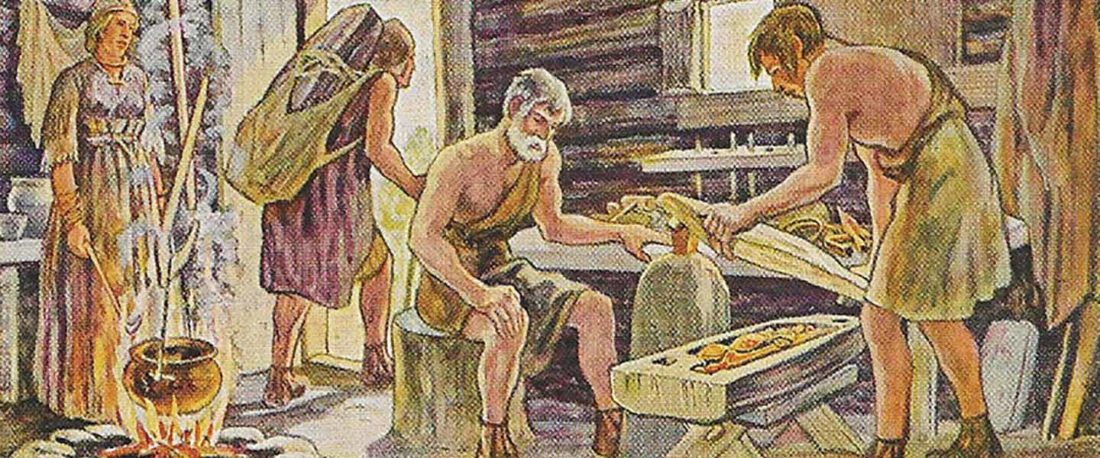
PU (Saa., Fi., Md., Ma., P, Ms.?, Kh., Smy.?) *wäśkä (*waśki?) ‘copper; ore, brass’ (UEW Nº 1123; Kallio 2006: 6). Irregular cognates suggest it might have been borrowed during the split-up of Proto-Uralic (cf. Aikio 2015: 42). However, compare potentially regular cognates from *wäskä in PFi. *vaski ‘ore, copper, bronze; brass’ (Kallio 2012: 167; Zhivlov 2014: 115), PSaa. *weśkä ‘copper; brass’, Md. Kazhlodka viśkä ‘chain’ (Häkkinen 2012: 18), and possibly Hu. *vas ‘iron’ (Zhivlov 2013), … Read the rest “Proto-Uralic Homeland (VI): Mythology & Metallurgy”

Proto-Uralic Homeland (V): Technology & Trade

technology-schnurtoepfer

This post is part of a draft on palaeolinguistics and the Proto-Uralic homeland. See below for the color code of protoforms.

8. Technology

8.1. Pottery

PU (Fi., Ma., Kh., Ms., Hu.) *pata ‘pot’ (UEW Nº 710) has a striking resemblance with NWIE *pod-óm, cf. PGmc. *fatą ‘vat, vessel’, Lith. púodas ‘pot’ (Kroonen 2013: 131; Dérksen 2015: 372). However, a Pre-PGmc. origin of a PFU stem seems unlikely – based on the lack of any other case with such a large distribution. Assuming that an unattested PIIr. **padá- underlies the PU form (cf. Parpola & Carpelan 2007: 122) … Read the rest “Proto-Uralic Homeland (V): Technology & Trade”

Proto-Uralic Homeland (IV): Animal Husbandry

animal-husbandry-neolithic

This post is part of a draft on palaeolinguistics and the Proto-Uralic homeland. See below for the color code of protoforms.

7. Animal Husbandry

7.1. Milk

PFU (Saa., Fi., Md., Ma., P, Kh., Ms. Hu.) *waji ‘butter/grease’ (UEW Nº 1156).

NOTE. Aikio (2019: 48) contra Häkkinen (2009: 28-30) considers an original meaning ‘grease’ more likely than ‘butter’. Indeed, a more general meaning is always the most conservative approach. In fact, it was possibly borrowed from Smy. into PTurk. *bań ‘fat, grease; edible oil, butter; lubricant’ (Czentnár 2015: 9-17). What is striking about Aikio’s comments on this and the Read the rest “Proto-Uralic Homeland (IV): Animal Husbandry”

Proto-Uralic Homeland (III): Agriculture & Apiculture

agriculture-plough

This post is part of a draft on palaeolinguistics and the Proto-Uralic homeland. See below for the color code of protoforms.

5. Apiculture

5.1. Honey and honeybees

PU (Saa. ← Fi., Md., Ma.?, Hu., P → Smy.) *meti ‘honey, nectar’ (UEW Nº 539) ← PIE/Pre-PIIr. *medʰu ‘honey, mead’.

NOTE. The specific source PIE stage is impossible to determine with precision. For supporters of Indo-Uralic, the dental could represent the divergent evolution in both dialects (Kümmel 2019). However, the substitution of PIE *dʰ for PU *t and final PIE *-u for PU *-i are regular changes in Late PIE/Pre-PIIr. Read the rest “Proto-Uralic Homeland (III): Agriculture & Apiculture”

Proto-Uralic Homeland (II): Forests & Climate

neolithic-havelland-culture

This post is part of a draft on palaeolinguistics and the Proto-Uralic homeland. See below for the color code of protoforms.

3. Forests

3.1. Regular terms

PU (Saa.? Fi., Md., Ma., Ms., Hu.? Smy.) *kojwa ‘birch’ (UEW Nº 334).

PU (Saa., Fi., Ma., P, Kh., Ms.) *ćänä ‘bracket fungus’ (UEW Nº 995; Aikio 2020: 115 with references).

PU (Md., Ma., Hu.) *ćalV/*će̮li/*ćälV ‘elm’ (UEW Nº 926), from PMd. *śäľǝŋ, PMa. *šolǝ, Hu. szil (Aikio 2020: 101 with references).

PU (Saa., Fi., Md., Ma., P, Kh., Ms., Smy.) *kowsi/*kusa ‘spruce; fir’ (UEW Nº 429, Aikio 2020: 46 … Read the rest “Proto-Uralic Homeland (II): Forests & Climate”