Vikings, Vikings, Vikings! Hordes of high quality ancient DNA

vikings-admixture-modern

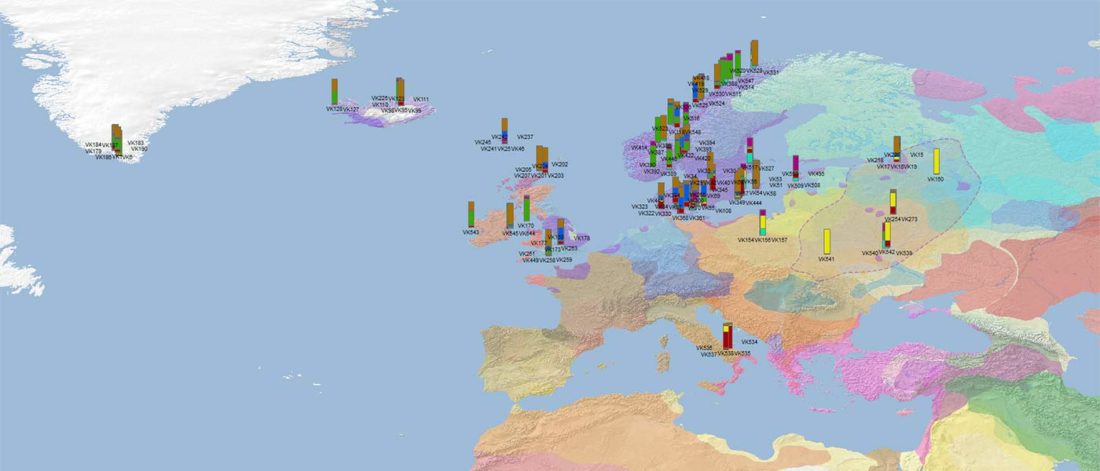
Recent paper (behind paywall) Population genomics of the Viking world, by Margaryan et al. Nature (2020), containing almost exactly the same information as its bioRxiv preprint.

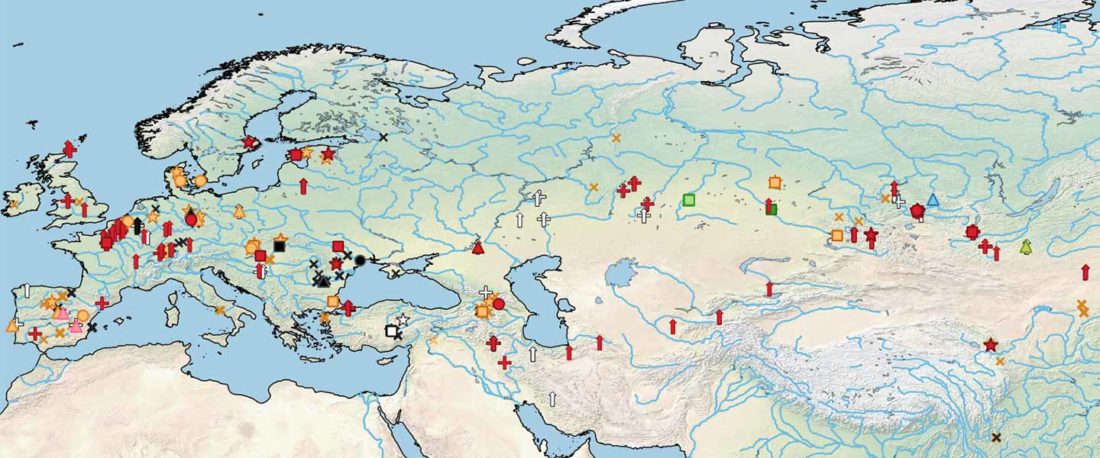
I have used Y-SNP inferences recently reported by FTDNA (see below) to update my Ancient DNA Dataset and the ArcGIS Online Map, and also to examine the chronological and geographical evolution of Y-DNA (alone and in combination with ancestry).

Sections of this post:

  1. Iron Age to Medieval Y-DNA
  2. Iron Age to Medieval Ancestry
  3. Iron Age to Medieval Y-DNA + Ancestry
  4. FTDNA’s big public debut

I. Iron Age to Medieval

Read the rest “Vikings, Vikings, Vikings! Hordes of high quality ancient DNA”

Origin of DOM2 closing in on the Pontic-Caspian steppes

horse-domestication-dna

Open access Ancient DNA shows domestic horses were introduced in the southern Caucasus and Anatolia during the Bronze Age by Guimaraes et al. Sci Adv. (2020) Vol. 6, no. 38, eabb0030.

Here is a good summary:

Our study of ancient equid remains from Anatolia and the southern Caucasus covering ~9000 years of the Holocene analyzed the dynamics over time of mitochondrial lineages and tested the hypothesis that Anatolia was a center of horse domestication. We were able to identify mitotypes characteristic of local Anatolian wild horses, which were regularly exploited in the early and middle Holocene. However, we identified a

Read the rest “Origin of DOM2 closing in on the Pontic-Caspian steppes”